Window of Tolerance: Why You Feel Fine One Moment and Completely Overwhelmed the Next
Have you ever wondered why some days you can handle almost anything, while on other days a simple text message, a crying child, or someone asking, "Can we talk?" feels unbearable?
Or perhaps you've noticed that you don't always become anxious. Sometimes you simply shut down. You stop responding to texts. You stare into space. You feel numb, exhausted, or disconnected from yourself.
These experiences are not signs of weakness.
They are signs that your nervous system has moved outside its Window of Toleranance.
As a trauma-informed therapist, I spend a great deal of time helping clients understand that emotional regulation is not about trying harder. It's about understanding what your nervous system is doing and learning how to guide it back to safety.
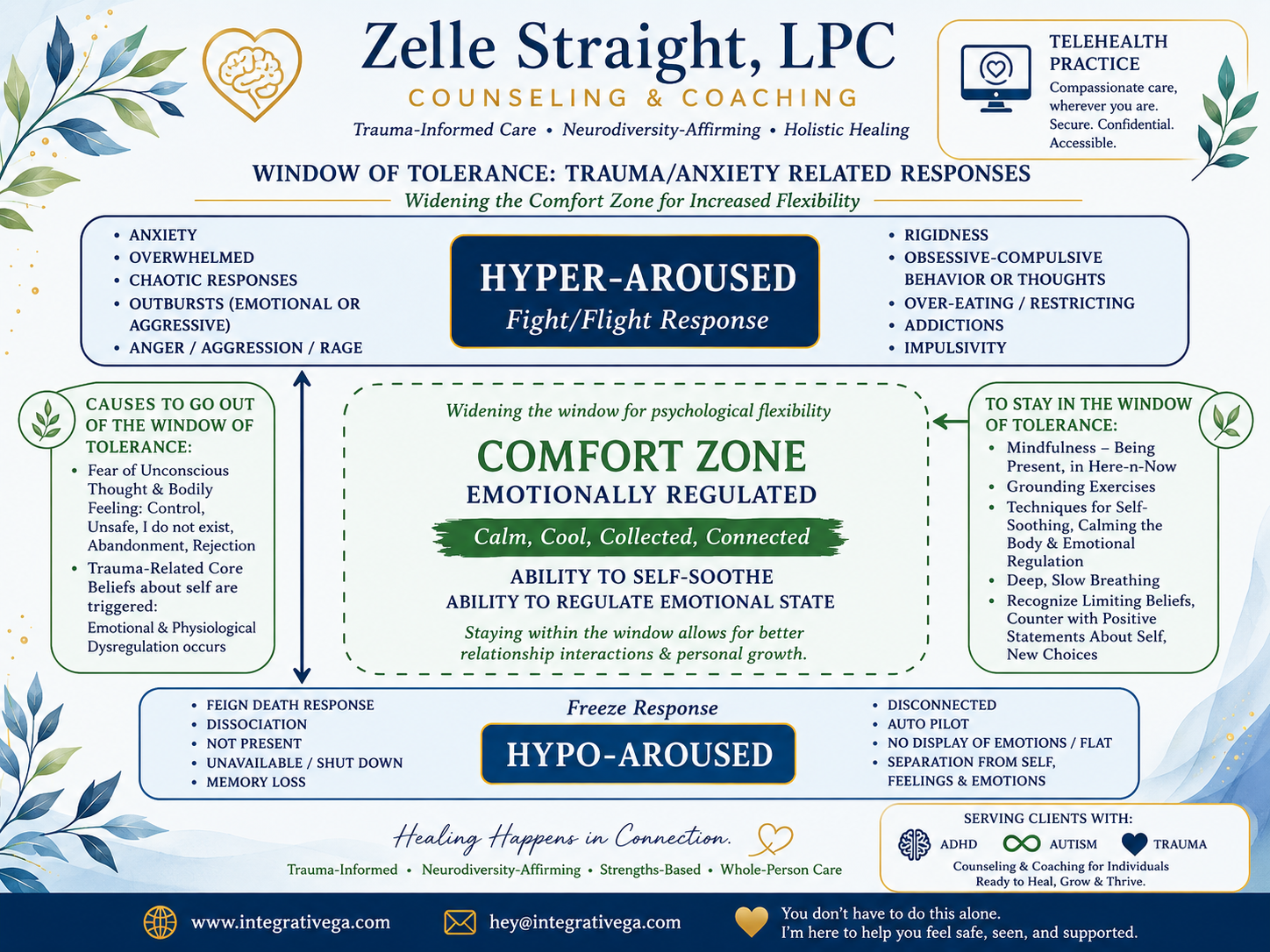
Window of Tolerance
What Is the Window of Tolerance?
The Window of Tolerance is the range in which your brain and body can effectively manage stress while remaining emotionally regulated.
When you're inside your window, you can:
Think clearly
Problem solve
Stay connected with others
Feel emotions without becoming consumed by them
Recover from stress more easily
Make intentional decisions instead of reactive ones
Being regulated does not mean feeling happy all the time.
It means your nervous system is flexible enough to experience emotions without losing access to your thinking brain
Think of your Window of Tolerance like the suspension on a car.
A well-functioning suspension can handle bumps without throwing everyone inside the vehicle around. A narrowed window feels like driving with no suspension at all. Every bump feels enormous.
Trauma, chronic stress, burnout, neurodivergence, medical conditions, sensory overload, and unpredictable environments can all narrow this window.
Hyperarousal: When Your Nervous System Gets Stuck on the Gas Pedal
Hyperarousal is the body's fight-or-flight response.
Your brain believes something is wrong, whether or not there is actual danger.
You might experience:
Racing thouhgts
Anxiety
Panic attacks
Irritability
Anger or rage
Feeling overwhelmed by small tasks
Restlessness
Difficulty sleeping
Muscle tension
Heart racing
Emotional outbursts
Obsessive thinking
Feeling like you have to fix everything immediately
A Real-Life Example
You receive an email from your boss asking to meet tomorrow.
Within minutes your brain has decided you're getting fired.
Your heart races.
You reread every email you've ever sent.
You can't focus on dinner.
You become short-tempered with your partner.
Nothing has actually happened yet, but your nervous system is already preparing for survival.
Hypoarousal: When Your Nervous System Hits the Brakes
If your body decides that fighting or escaping won't work, it may shift into shutdown.
This is hypoarousal.
Instead of becoming energized, everything slows down.
You might notice:
Feeling emotionally numb
Brain fog
Fatigue
Dissociation
Feeling disconnected from yourself
Wanting to sleep excessively
Difficulty making decisions
Low motivation
Feeling frozen
Avoiding responsibilities
Memory problems
Feeling like you're watching life happen from the outside
A Real-Life Example
You've had several stressful weeks.
A friend texts asking if you want to meet for coffee.
Instead of replying, you stare at your phone.
Hours pass.
Then days.
You aren't ignoring them because you don't care.
Your nervous system has essentially gone offline to conserve energy.
Pendulating Between Hyperarousal and Hypoarousal
Many people don't stay in one state.
Instead, they swing between them.
This is especially common after chronic trauma, childhood emotional neglect, prolonged stress, burnout, and in many neurodivergent nervous systems.
One day you may feel:
"I have to clean the entire house."
Six hours later you're lying in bed unable to move.
Or you spend all morning anxiously researching a medical symptom.
By afternoon you're completely exhausted and emotionally numb.
Or perhaps you desperately want connection while simultaneously canceling every plan because being around people feels impossible.
These shifts can be confusing because they seem contradictory.
They're actually different survival strategies from the same nervous system.
Your body is trying to find safety.
Why Trauma Narrows the Window
When someone has experienced trauma, the brain becomes exceptionally good at detecting possible danger.
Unfortunately, it often begins responding to reminders of past experiences instead of present reality.
A disappointed facial expression.
Someone raising their voice.
A delayed text.
Conflict.
Feeling criticized.
Even positive life changes can activate old survival responses.
The nervous system isn't asking:
"Am I safe?"
It's asking:
"Does this feel familiar?"
If something resembles an old threat, your body may react long before your thinking brain catches up.
Regulation Tools for Hyperarousal
When you're activated, your goal is not to force yourself to calm down.
Your goal is to show your nervous system that the threat has passed.
Helpful strategies include:
Slow Your Exhale:
Breathe in for four seconds.
Breathe out for six to eight seconds.
A longer exhale activates the parasympathetic nervous system.
Apply Temperature
Splash cold water on your face.
Hold an ice pack against your cheeks.
Drink cold water slowly.
Temperature changes can interrupt escalating anxiety.
Heavy Work
Push against a wall.
Carry groceries.
Use resistance bands.
Lift weights.
Deep muscle activation helps discharge survival energy.
Orient to Safety
Look around the room.
Name:
Five things you see
Four things you hear
Three things you feel
Remind yourself:
"I am here."
"I can feel my feet on the floor."
"I’m in my space (room, chair, bed, etc)."
Reduce Stimulation
Dim lights.
Lower noise.
Take a break from social media.
Step outside.
Many nervous systems simply have too much incoming information.
Regulation Tools for Hypoarousal
When you're shut down, calming activities may actually make you feel more disconnected.
Instead, your nervous system often needs gentle activation.
Try:
Movement
Walk around the block or around your house.
Stretch.
Dance to a favorite song.
Rock in a chair.
Increase Sensory Input
Open the blinds.
Go outside.
Smell something like coffee, an orange, a candle, soap.
Listen to upbeat music.
Chew gum.
Connect with Another Person
Text someone safe.
Sit beside another person without needing to talk.
Sometimes nervous systems regulate through connection before they regulate alone. This is called co-regulation.
Small Achievable Tasks
Rather than cleaning the whole kitchen:
Wash one plate.
Fold five shirts.
Reply to one email.
Small wins help restart motivation without overwhelming your nervous system.
What If You Keep Swinging Between the Two?
If you find yourself bouncing from panic to shutdown, your nervous system may need rhythm rather than intensity.
Consider:
Alternate Activation and Rest
Walk for five minutes.
Then sit quietly.
Stretch.
Then practice slow breathing.
This teaches flexibility rather than forcing one state.
Practice Pendulation
Borrowed from somatic therapies, pendulation involves gently noticing moments of activation while also noticing moments of safety.
For example:
"I notice tension in my chest."
"I also notice my feet feel supported by the floor."
Rather than becoming consumed by distress, you teach your brain to move back and forth between activation and regulation.
Create Predictability
The nervous system loves routines.
Consistent wake times.
Regular meals.
Movement.
Adequate sleep.
These seemingly simple habits provide powerful signals of safety.
Reduce the Need for Perfection
Many people become dysregulated because they believe everything has to be done immediately and perfectly.
Learning to tolerate "good enough" often widens the Window of Tolerance more than trying harder ever could.
Widening Your Window Takes Practice
Healing isn't about eliminating anxiety.
It isn't about never shutting down.
It isn't about becoming calm 100% of the time.
Healing is increasing your ability to notice what's happening, respond with compassion instead of shame, and return to regulation more quickly.
Over time, your Window of Tolerance expands.
Situations that once felt overwhelming become manageable.
Recovery becomes faster.
Relationships feel safer.
Your nervous system begins to trust that you can handle life's inevitable stressors.
That is what resilience truly looks like.
You Don't Have to Figure It Out Alone
If you frequently experience anxiety, emotional overwhelm, burnout, shutdown, chronic stress, trauma responses, or find yourself constantly swinging between hyperarousal and hypoarousal, therapy can help you better understand your nervous system and develop individualized tools that actually work for your brain.
At Integrative Counseling of GA, I provide trauma-informed therapy and coaching for adults navigating trauma, anxiety, neurodivergence, relationship challenges, and nervous system dysregulation. Together, we can help you understand why your body responds the way it does, widen your Window of Tolerance, and build lasting emotional flexibility.
To learn more or schedule an appointment, visit www.integrativega.com or email hey@integrativega.com. Your nervous system isn't broken. It adapted to help you survive. Healing is about helping it learn that it no longer has to survive alone.